



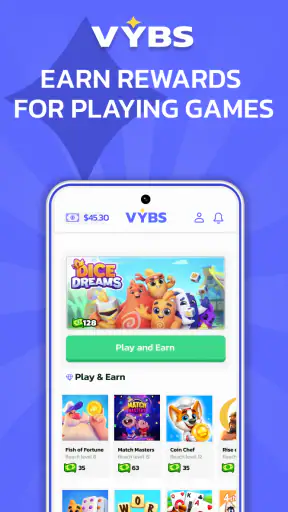
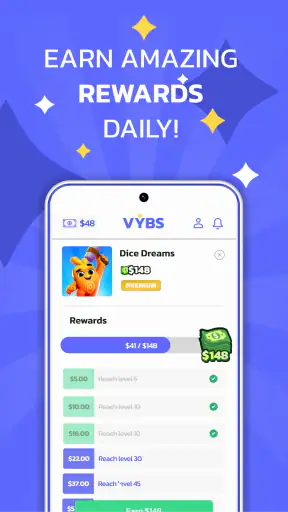
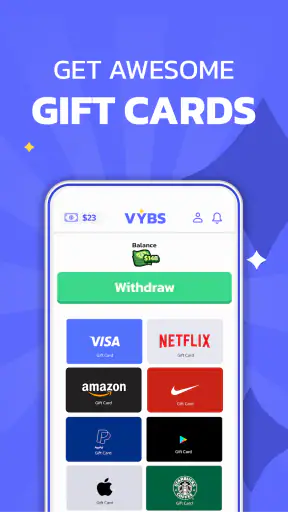
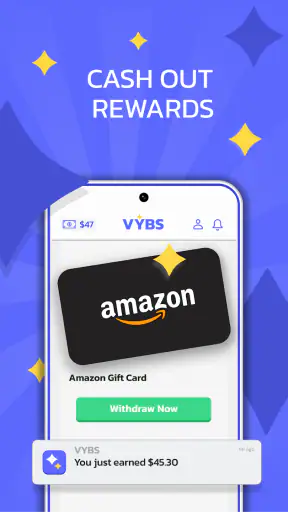
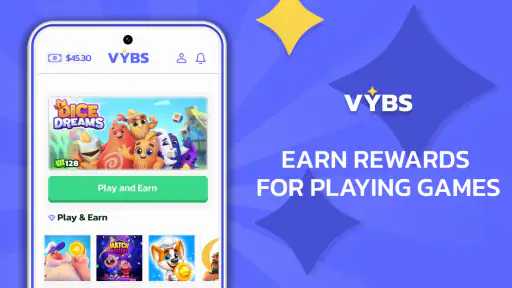

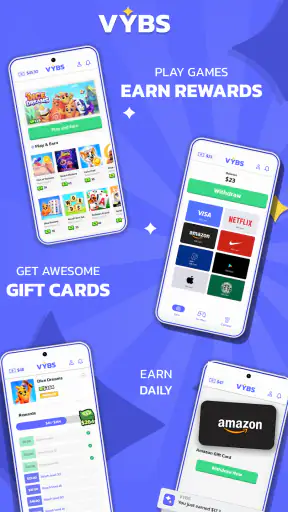
I approached VYBS: Play & Earn Rewards with a simple question: does it remain useful after the initial excitement of earning rewards wears off? This free lifestyle app from VYBS ENTERTAINMENT is built around playing games and working toward gift-card rewards, so its appeal is easy to understand. It gives casual gaming a practical purpose without asking me to treat every session like a serious hobby.
The first impression is deliberately straightforward. The service is aimed at people who already enjoy playing on their phone and would rather receive something tangible than collect an entirely virtual score. In my experience, that makes it more interesting than a standard game catalog, but also more demanding than a normal entertainment app. The real question is not whether the concept is attractive; it is whether the routine stays worthwhile once the novelty has faded.
From an appealing first week to a sustainable routine
Why the opening experience feels rewarding
The strongest part of the first week is the low barrier to entry. I do not need to learn a complicated creative tool or commit to a long competitive season. I can open the app when I have a spare moment, play, and keep an eye on progress toward rewards. That makes it a natural fit for short breaks, waiting rooms, public transport, or the few minutes before bed when I want something lighter than a full game.
Its store summary promises a path from gaming to real payouts, while the short store description simply identifies the product as VYBS. That contrast tells me something useful: the app’s identity is intentionally compact. It is not trying to replace a dedicated gaming platform. Instead, it adds a reward layer to mobile play, which is most appealing when I already have the habit of playing casually.
During an early trial, I would focus less on the reward headline and more on the complete loop: how quickly I can find something playable, how clearly progress is presented, and how much attention is required between sessions. A reward app can feel excellent at the beginning because every action is new. The better test is whether I can return without feeling that I am managing a second job.
One practical tip is to treat the first week as an evaluation period rather than immediately building my routine around the promised payout. I would check how the available games fit my tastes, whether the progress feels understandable, and whether redeeming a reward is a convenient conclusion to the process. This prevents the common mistake of judging the whole experience from the excitement of the first few sessions.
The right everyday scenario
VYBS makes the most sense for a person who already spends small pockets of time gaming. Imagine finishing lunch early and having ten minutes before returning to work. A conventional game can fill that gap, but the session disappears as soon as it ends. With this app, the same kind of break can contribute toward a reward, provided the available activity is enjoyable enough to repeat.
That use case is more convincing than trying to force long sessions. If I sit down specifically to maximize earnings, I may start judging every minute against the eventual gift card. That changes the mood from casual entertainment to repetitive task completion. The app works better when rewards are an extra benefit attached to play, not the only reason I can tolerate the play itself.
It is also worth deciding in advance what kind of reward would feel meaningful. A small gift card can be satisfying when it arrives as a bonus from time I would have spent gaming anyway. It feels much less attractive if I am sacrificing other activities or repeatedly checking progress. This is the central trade-off: the app can make idle gaming feel more purposeful, but it cannot turn every spare minute into equally valuable time.
Who will enjoy the first-week novelty
Casual players are the obvious audience. Someone who likes trying different mobile games, enjoys visible progress, and does not mind changing activities may find the format refreshing. It can also suit users who prefer small, attainable milestones rather than a single distant objective. The reward framing gives ordinary play a sense of direction, especially during the early sessions when progress feels new.
People who want one deep game with a stable community may be better served elsewhere. VYBS is not the choice I would make for a player looking for a carefully balanced competitive system, a large narrative adventure, or a single title to master for months. Its value comes from the combination of variety and incentives, not from replacing a specialist gaming experience.
The mature age classification matters too. This is intended for adults, not younger players looking for a family-friendly reward activity. I would take that rating seriously when deciding whether to install it on a shared device or recommend it to someone underage. The app’s audience is clearly not children, even though the basic idea of playing for rewards can sound broadly appealing.
What changes after the first month
After the initial curiosity, the experience becomes a question of repetition. The first sessions are carried by discovery; later sessions depend on whether the available play remains pleasant and whether progress feels worth the attention. At this stage, I would stop asking, “Can I earn something?” and start asking, “Would I still open this if the reward were not immediately visible?”
That question is useful because it separates lasting value from novelty. If I enjoy the underlying games, the reward system can remain a welcome bonus. If I only tolerate the games because of the payout, fatigue is likely to arrive quickly. No reward structure can fully compensate for activities that do not match my preferences.
A sensible monthly routine would be occasional rather than compulsive. I would open the app during naturally available downtime, review what I want to play, and avoid stretching sessions simply to chase a target. This approach protects the entertainment value and makes the reward feel like a by-product of a habit I already enjoy.
How to judge recurring value
For month-to-month use, I would pay attention to three practical questions. First, do I still find at least some of the available play enjoyable? Second, is the progress clear enough that I know what my activity is contributing toward? Third, does the reward process feel simple enough to justify returning? These are more important than the headline promise because they determine whether the app earns a permanent place on my phone.
Another useful habit is to compare VYBS with what I would otherwise do during the same time. If the alternative is a game I genuinely love, the reward layer may not add enough to change my choice. If the alternative is aimless scrolling, however, VYBS has a stronger case. The app’s recurring value depends heavily on the opportunity cost of my free time.
I would also avoid treating the displayed progress as a personal income plan. The sensible mindset is “bonus for gaming,” not “reliable earnings.” That distinction keeps expectations realistic and reduces the temptation to spend more time than the experience deserves. Anyone seeking dependable financial returns should skip this category entirely and choose a legitimate work or savings tool instead.
The maintenance burden people notice later
Every reward app asks for more attention than a normal game, even when the interface looks simple. I have to remember that it exists, decide which activity is worthwhile, keep track of progress, and eventually complete the redemption step. None of those tasks is necessarily difficult, but together they create maintenance. The app earns long-term space only if that maintenance stays lighter than the value I receive.
My advice is to create a small personal rule: use it only during gaming time I already planned to spend, and check progress at natural stopping points rather than constantly. That avoids turning the phone into a dashboard I monitor throughout the day. It also makes it easier to notice whether the experience is still enjoyable or has become an obligation.
Storage and attention are part of the decision as well. A phone can accumulate many apps that each promise a small benefit, yet the combined clutter becomes tiring. I would keep VYBS installed only if I return to it regularly enough for the reward path to feel relevant. If weeks pass without opening it, removing it and reinstalling later may be more sensible than keeping another unused icon in the app drawer.
The current version is 1.78.0, and the app requires Android 8.0 or later. That makes compatibility reasonably broad for many Android users, but I would still check the operating system before planning around it. Version numbers can change over time, so I would also keep an eye on update behavior in the relevant app store rather than assuming the first installation experience will remain identical.
Where fatigue begins
The first source of fatigue is repetition without enough personal choice. If the reward objective becomes more important than the quality of the play, I may find myself continuing activities that no longer feel entertaining. A second source is interruption: opening an app to relax feels different when I am repeatedly thinking about the next milestone or redemption step.
There is also a psychological trap in small rewards. Because each individual session feels harmless, it is easy to continue longer than intended. The right response is not to chase every possible point of progress, but to set a stopping time before I begin. That simple boundary keeps the app in the lifestyle category rather than letting it dominate my leisure.
Another limitation is that the reward concept can make comparisons unfair. A conventional game may offer richer controls, better storytelling, or more satisfying long-term progression. VYBS has to be judged on a different scale: convenience, variety, and the extra value attached to play. If I compare it directly with a premium game purely on depth, it will not be the right tool; if I compare it with unstructured downtime, it becomes more compelling.
Privacy, trust, and sensible expectations
Before committing to any rewards service, I would read the current store information and the app’s own terms carefully, especially around account handling, redemption steps, and any requirements shown during use. I would not provide more personal information than necessary, and I would avoid assuming that every reward is equally easy to obtain. A careful user verifies the final steps before investing significant time.
This is particularly important because the app is free. “Free” removes an upfront purchase, but it does not mean my time has no value. I would evaluate the experience by asking whether the entertainment and eventual reward justify the attention involved. If the answer becomes no, uninstalling is a reasonable decision rather than a failure to complete the system.
The app’s audience size suggests that the concept has reached a substantial number of Android users: it has more than a million installs, with an average rating of 4.7 from roughly 151 thousand ratings and about 16 thousand written reviews. Those figures indicate strong public interest, but they should not replace my own judgment. A popular reward app can still be a poor match for someone who dislikes casual variety or prefers predictable, uninterrupted play.
How it compares with ordinary alternatives
Compared with a standard mobile game, VYBS offers a practical incentive but may add a layer of tracking and decision-making. A normal game is usually simpler: launch it, play it, and stop. VYBS is more attractive when I want my casual gaming time to work toward something outside the game, but less attractive when I value frictionless entertainment above all else.
Compared with passive social scrolling, it can provide a clearer sense of purpose. I am at least choosing an activity rather than endlessly refreshing a feed. Still, it is not automatically healthier or more productive simply because rewards are involved. If I use it to extend my screen time, the reward may not offset the extra time spent on the phone.
Compared with paid games, the free entry is a clear advantage for experimentation. I can explore the concept without making an upfront purchase. The trade-off is that the reward model becomes part of the experience, and my enjoyment may depend on how well the available activities fit my preferences. Players who know they want a focused, polished game may prefer to pay once and avoid the incentive layer.
Who should keep it installed
I would keep VYBS on my phone if I regularly play casual mobile games, appreciate small rewards, and can use it without obsessively monitoring progress. It is especially suitable for turning otherwise empty moments into structured play. The strongest users are not necessarily the people who chase the most activity; they are the people who can maintain a relaxed routine and stop when the session stops being fun.
I would skip it if I expect predictable income, dislike reward thresholds, or become frustrated when entertainment includes extra steps. It is also a poor fit for anyone under the mature age classification, or for someone who wants a single game with deep progression rather than a reward-oriented lifestyle experience.
My practical recommendation is to begin with a limited trial, decide how much time I am willing to give it, and judge the complete path through redemption rather than the opening screen. If the app fits naturally into existing gaming habits, it can make those habits feel a little more worthwhile. If it requires constant attention, the novelty is not enough to justify the space.
The lasting verdict
VYBS: Play & Earn Rewards succeeds most clearly as a casual companion, not as a replacement for work, a serious gaming platform, or a dependable source of money. Its free price makes experimentation easy, and the reward idea gives ordinary mobile play an extra reason to return. The first week can be appealing because the loop is fresh and the goal is easy to understand.
Its long-term test is stricter. The app needs to remain light, enjoyable, and simple enough that maintenance does not overshadow the benefit. I would not force a monthly habit just to justify keeping it installed. Instead, I would let actual downtime decide: if I am already in the mood to play, VYBS can add useful motivation; if I am opening it only to chase progress, it has probably lost its value.
My final view is cautiously positive. The strong rating and broad install base show that the format resonates with many people, while the mature classification, Android requirement, and reward-focused design define a fairly specific audience. For a casual player who wants a little more from spare gaming time, it is worth trying. For anyone demanding depth, guaranteed returns, or completely maintenance-free entertainment, a conventional game or a different kind of lifestyle app will be the better choice.


